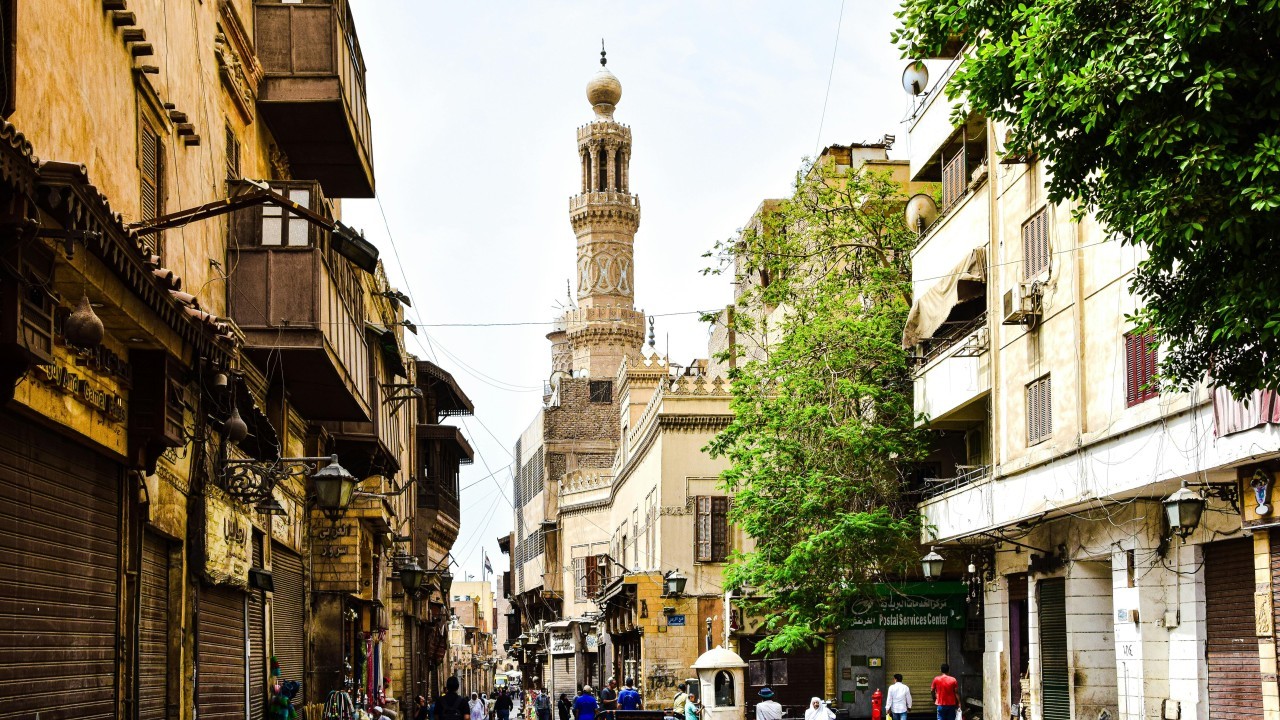

Across the Middle East, from Cairo’s new compounds and cities, to Dubai’s master‑planned communities, an increasingly dominant trend is appearing: the rigid separation of residential and commercial zones, supported by car‑dependent infrastructure. This model echoes mid‑20th-century Western suburban planning, a model now being reversed in many Western cities due to its social, economic, and environmental shortcomings.
Exploring development trends in the Middle East.
The Middle East's car-centric developments are undermining livability and legacy. What we're seeing is is a shift from traditional communities that are urban and walkable, to isolated and drive dependent.
What’s especially concerning is that the Middle East, still grounded in a heritage of walkable, mixed-use urbanism, is chasing this outdated model, just as its flaws become impossible to ignore. On a trajectory that will be hard to reverse from if addressed too late.
📊 Aging Populations Demand Accessible Communities
The Middle East is undergoing a rapid demographic shift. Today, people aged 60+ account for approximately 4.7% of the MENA region’s population. By 2050, that figure will nearly triple, reaching 12% on average, and over 20% in at least six countries.
Egypt’s own aging transition is striking: only 6.9% of Egyptians were 60+ in 2015, rising to 9.2% in 2021—and projected to surpass 20% by 2050, equating to around 20 million elderly citizens. An aging population demands walkable communities with access to daily needs, something car-centric zones simply don’t provide.
🚗 Car Dependency Is a Regional Issue
Urban mobility in the region remains heavily reliant on private vehicles:
In Lebanon, private cars account for roughly 80% of passenger trips, far above the estimated efficient public transport share of 40%.
In Abu Dhabi, 80% of households own one or two cars, and vehicle ownership was growing at an estimated 24% per year as of 2018.
In Dubai, there are 541 cars per 1,000 residents, higher than New York (444), London (345), or Singapore (111), and residents spend about 1 hour 45 minutes daily commuting.
These figures reflect vast investment in highway infrastructure, but limited integration with sustainable, first-mile/last-mile transport.
🏘️ Zoning Trends Create Spatial Disconnection
The community planning for many new Middle Eastern developments follow a predictable pattern:
Low-density residential zones often walled or gated.
Commercial centers located separately, requiring car travel.
Little to no pedestrian infrastructure linking them.
These designs recreate the North American suburban model, now being outgrown in global cities seeking regrowth and regeneration with elements and social structures seen in the traditional communities such as those that still exist in the Middle East.
🌎 Western Cities Are Reversing Course
Urban planning trends are shifting:
Portland and Melbourne have adopted “15-minute city” models.
Barcelona with its “Superblocks” is reducing car traffic to promote walkability.
Paris champions the “ville du quart d’heure”, ensuring most daily needs are accessible on foot.
These cities recognize that mixed-use, pedestrian-friendly environments boost health, economic activity, environmental sustainability, and real estate values. Meanwhile, the Gulf and North African zones remain rooted in the outdated car-centric paradigm as they work to adopt their understanding of modernization, in efforts to expand their economies.
👬 Loss of Community and Cultural Dissonance
Historically, Middle Eastern cities were walkable by default. Neighbourhoods were organically mixed-use: housing, mosques, shops and markets, hammams, schools, all woven into the urban fabric. This promoted:
Frequent social interaction.
Strong support networks.
Emotional and spiritual well-being.
By contrast, modern zoned developments isolate residents, eroding community bonds and rendering public space invisible to daily life.
📈 Costs of Car-Dependent Development
Traffic fatalities: In 2024, Egypt recorded 5,260 road deaths, with a mortality rate of 4.9 per 100,000 people (CAPMAS). Pedestrians remain the most affected, and road accidents cost the economy up to 4% of GDP (~$8B annually).
Congestion losses: In Cairo, traffic congestion causes an estimated $8 billion in annual economic losses, equal to around 3.6% of Egypt’s GDP (World Bank). In Dubai, drivers lose over 80 hours per year in traffic, costing the city AED 4.6 billion (~US $1.3 billion), 3.15% of GDP, every year, in lost productivity and fuel waste.
Pollution: In Egypt, vehicle emissions contribute to over 25% of urban air pollution, with Cairo ranked among the world’s most polluted cities by PM2.5 concentration ([IQAir, 2023]). In the Gulf, private vehicles account for over 50% of emissions in cities like Riyadh and Abu Dhabi, where car dependency worsens air quality despite smaller populations.
Vehicle-dependency also burdens households, consumes public funds, and degrades quality of life.
🌍 Turning a New Page: Regional and Global Alternatives
Some Middle Eastern developments show promise:
Masdar City (UAE): prioritizes pedestrian movement and personal rapid transit.
Doha’s Souq Waqif regeneration emphasizes transit-oriented design and equitable access.
Abu Dhabi’s Capital District Plan emphasizes mixed-use neighborhoods.
Internationally, Freiburg’s Vauban, Melbourne’s 20-minute neighborhoods, and Barcelona’s Superblocks demonstrate that pedestrian-first planning delivers health, community, and economic benefits.
🎩 Reframing “Luxury” and Planning for Resilience
For the region to lead and not lag, urban innovation and high-end should mean:
Mixed-use neighborhoods: homes, shops, clinics, schools within walking distance.
Inclusive public space: parks, plazas, shaded streets that foster social life.
Pedestrian and transit infrastructure: safe paths, frequent networks, first-mile/last-mile connectivity.
Aging-friendly design: accessible clinics, benches, ramps, and proximity to essentials.
The goal is livability, not just the appearance of luxury, or isolated luxury.
What Comes Next: Building Differently
If the Middle East is at a crossroads in its urban evolution, then it needs more than policy tweaks and surface-level innovation. It needs a new mindset, a redefinition of what modern development actually means.
The data is clear. The challenges are global. But the opportunity is regional.
The goal now must be to move beyond reactive design and outdated replication, and toward proactive, human-centric development rooted in the region’s own cultural, social, and climatic logic. To do that, the Middle East needs to stop asking “How do we modernize?” and start asking “What kind of future do we want to live in?”
That’s where A77 comes in.
🧠 A77’s Lens: Build for People, Not Just Projects
At A77, we’re not just consultants, designers, or creatives, we’re a think tank shaping the next generation globally, and we're here to do so for Middle Eastern cities. Our approach combines deep regional insight with redefined innovative best practices. We challenge assumptions, redefine value, and design for resilience across generations.
We believe the region doesn’t need to chase global models. It can lead with its own.
From Zoning to Living
Old mindset: Define plots as residential, commercial, medical, or retail, then link them with roads.
Our approach: Design blocks where all functions coexist, at human scale. Think in terms of daily ecosystems. Can a person live, eat, work, care for a loved one, meet friends, and access support, all within a walk?
These integrated blocks are:
Healthier for aging populations
More profitable for local businesses
More resilient during crises (like COVID or fuel disruptions)
More vibrant, active, and economically inclusive
From Value Per Square Meter → Value Per Life Lived
Old mindset: Maximize floor area and yield for short-term sale value.
Our approach: Optimize for lifetime value, not just of the building, but of the people living in it. This automatically increases value per square meter as well.
That includes:
Long-term community retention
Generational housing adaptability
Economic diversity and inclusion
Access to micro-care, community wellness, and mobility independence
We ask, "What is the experience of this block over 30 years? What are the costs avoided, healthcare, commuting, environmental degradation, by building better upfront?"
From Amenities as Add-ons → To Infrastructure as Livelihood
Pools, gyms, and clubhouses aren’t enough.
We help reimagine amenities as critical layers of economic and social infrastructure, such as:
Mini-clinics and pharmacies for routine care, not just emergencies
Mental health pods, prayer spaces, and reflection areas
Shared food prep kitchens for home-based or small food businesses
Youth coworking labs with skill training and startup support
Small-format retail units for local entrepreneurs, not just global chains
These aren’t luxuries, they’re modern necessities, especially as work and life continue blending post-pandemic. Those who adopt and realize the lifestyle and economic shift led by new generations will lead, those who don't won't just be left behind, they'll be forgotten.
From Gatekeeping to Generational Urbanism
Gated compounds are built for today’s buyer. But what happens when they want to age in place? Or when their children can’t afford to live nearby? Or when workers must commute 90 minutes just to serve them?
We help developers and cities design for continuity across generations, including:
Mixed-income housing in every development
Multiple housing formats within one block (young professionals, families, aging)
“Community ladders” that allow residents to grow economically without needing to leave their neighbourhood
If people are forced to move away at each life stage, then we’ve failed.
From Top-Down Plans → To Embedded Community Frameworks
Master plans rarely reflect how people live on the ground. That’s why we work closely with communities, even before the first stone is laid.
We offer:
Community engagement strategies
Resident input loops in design
Cultural and behavioral mapping (how do people actually move, meet, work, care?)
Programming layers integrated into the spatial framework
Development isn’t just about the space, it’s about what happens inside it, year after year, for generations.
From Replication to Regional Innovation
The Middle East has an urban design legacy that predates Western zoning entirely. Islamic cities were walkable, shaded, multifunctional, community-driven. There’s no need to replicate the West, especially as Western cities are trying to undo what we’re just now adopting.
What if we led with our legacy instead?
We believe the next wave of regional development should reflect:
Climate-smart materials and passive cooling
Walkable networks inspired by historic Arab urbanism
Multifaith, multigenerational spatial logic
Digitally connected, physically grounded civic life
This isn’t nostalgia, it’s relevance. It’s history modernized.
What Governments and Developers Should Do Now
If you’re a government body, real estate firm, or investment group in the Middle East, here’s where you start:
Audit current projects for walkability, diversity of use, and aging-readiness
Incentivize mixed-use zoning and penalize excessive spatial separation
Adopt mobility-first guidelines, not car-first networks
Use land allocation models that allow for economic layering, not just plot-sale profit
Pilot a new model: A small but fully-integrated, high-density, human-centred district as a demonstration of what’s possible
Let the Middle East Lead
This is the moment to lead, not copy. The region can build a model of 21st-century livability that works for its people, climate, and future. The challenge now is to shift policy and mindset, placing people, not cars, at the centre of development.
At A77, we’re already doing it. We’re ready to help others do it too.
Let’s not just build cities. Let’s build differently, on purpose.
A77. Build Different, On Purpose.
Sources:
https://pmc.ncbi.nlm.nih.gov/articles/PMC3767158/
https://wikiageing.org/index.php/Population_Ageing_-_Egypt_Report
https://www.worldbank.org/en/news/opinion/2014/05/07/doing-the-math-for-egypts-fatal-roads
https://www.iqair.com/world-most-polluted-cities
https://www.vision2030.gov.sa/media/rcnhvlja/transport-and-logistics-national-strategy.pdf
https://inrix.com/scorecard-city/?city=Dubai